
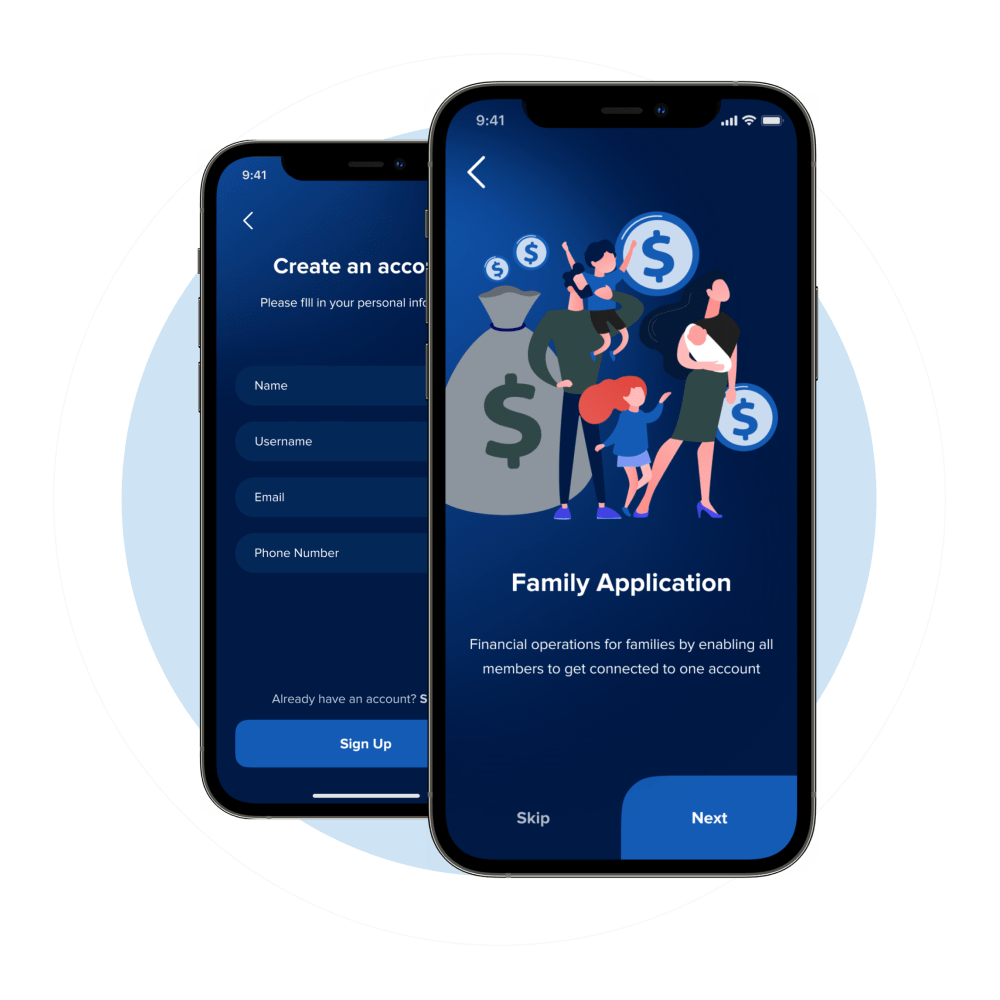
A fintech startup headquartered in Northern Europe approached us to hire mobile developers to reinforce their in-house development team working on an e-wallet for families. After a few interviews with our specialists, the client selected two candidates who were the best fit: a senior iOS developer and a mid-level Android developer. They started working on the client’s project shortly after signing the NDA.
In the middle of the process, the client decided to redesign the application’s interface. He was looking for a skilled designer with hands-on experience in creating interfaces for fintech solutions. At Itexus, we offer turnkey fintech software development, so we have UI/UX specialists on board who have extensive track record in the fintech domain. Thus, we offered the client to review the CVs and portfolios of our designers and they chose one for their project. In this way, three Itexus specialists were added to the client’s internal team – two mobile developers and one UI/UX designer.
Have you ever wondered how your smartwatch knows it’s you, or how your car can sense and avoid an obstacle? From the smart thermostat warming up your living room to the medical device monitoring a heartbeat, there’s an invisible force at work. That force is embedded software development – the art of coding the tiny computers inside our everyday devices to make them intelligent. This lively guide will peel back the layers of this fascinating field, exploring what it is, how it’s powering innovations across industries, and the exciting trends steering us toward a smarter future.
What is Embedded Software Development?
Embedded software development is all about writing programs for specialized microprocessors that live inside devices and machines. Unlike the software on your PC or smartphone, embedded software is typically dedicated to a specific function within a larger system. Think of the anti-lock braking system in a car or the firmware in a smart fridge – each is a piece of embedded software doing one job well. These programs have to run on small memory and computing power, but they are incredibly reliable and often work in real time (meaning they respond instantly as events happen).
To put things in perspective, embedded systems are literally everywhere. In fact, by some estimates, over 98% of all microprocessors can be found in embedded systems, not in general-purpose computers. Your microwave, washing machine, TV remote, and even your electric toothbrush likely each has a little chip running code. This ubiquity is why embedded software development is so important – it’s the backbone of modern electronics. If you’ve ever marveled at a gadget’s smarts, you’re appreciating the result of embedded developers’ work.
And it’s not just simple gadgets. Even complex, safety-critical equipment relies on embedded software. For example, a modern car contains dozens of tiny computers called ECUs (electronic control units) networked together. Together, they manage everything from engine timing to in-car entertainment. A premium car today might run on close to 100 million lines of code – that’s more than in some jet fighters or the space shuttle! Writing and maintaining this software is a huge task, which shows how crucial embedded software development has become in the age of smart tech.
Key Applications of Embedded Software Development Across Industries
Embedded systems touch virtually every industry. Let’s look at how this technology applies itself across a broad range of fields – from the car in your driveway to the hospital down the street:
| Industry | Examples of Embedded Software Applications |
| Automotive | Engine control units (ECUs) for fuel and emissions, advanced driver-assistance systems (ADAS) like automatic braking, airbag control modules, infotainment and GPS navigation systems. |
| IoT & Smart Homes | Smart thermostats and HVAC controllers, home security sensors and cameras, voice-activated assistants, smart lighting systems, and connected appliances (refrigerators, ovens) that can be monitored via smartphone. |
| Healthcare | Pacemakers and wearable heart monitors, insulin pumps and drug delivery systems, MRI and imaging machines, patient monitoring systems that track vital signs and alert caregivers in real time. |
| Manufacturing | Industrial robots on assembly lines, programmable logic controllers (PLCs) orchestrating factory machinery, sensor networks for predictive maintenance in equipment, and automation systems in warehouses and production plants. |
| Consumer Electronics | Smartphones and tablets (touchscreen controllers, sensors), smartwatches and fitness trackers, gaming consoles and VR headsets, smart TVs and streaming devices, digital cameras and drones. |
Across these industries, embedded software development enables innovation and efficiency. For instance, in the automotive sector, embedded software controls critical safety features: if you drive a car with lane-keeping or automatic emergency braking, you’re trusting code to keep you safe. (A striking fact: the Ford F-150 Lightning electric truck operates on about 150 million lines of code, far exceeding the 6.5 million in a Boeing 787’s avionics!) In healthcare, tiny embedded systems in pacemakers or insulin pumps are literally life-sustaining. And in manufacturing, embedded chips in industrial robots increase productivity while performing precise, repetitive tasks 24/7.
Embedded software development is the backbone of the Internet of Things (IoT), powering billions of devices from smart thermostats to fitness trackers. These devices collect data and make decisions locally, like adjusting temperature or counting steps. With an estimated 40 billion IoT devices expected by 2030, the demand for embedded developers is skyrocketing to program the “brains” of these smart gadgets.
Trends Shaping the Future of Embedded Software Development
As we look to the future, several exciting trends are shaping how embedded software is developed and what it can do. The field is evolving fast, blending with advancements in connectivity, artificial intelligence, and design methodology. Here are some of the major trends driving the next generation of smart tech in the embedded world:
- IoT Everywhere & 5G Connectivity: Embedded software development is riding the wave of the Internet of Things boom. From smart homes to smart cities, more devices start to connect. Emerging 5G networks (and upcoming 6G) provide the high-speed, low-latency connections needed to support massive numbers of gadgets communicating in real time. This means your future appliances, wearables, and even infrastructure will talk to each other seamlessly. We’re heading toward a world where connectivity is as expected as electricity – and embedded systems are the silent ambassadors making devices interoperable.
- AI at the Edge: Edge AI is bringing artificial intelligence directly onto devices like sensors, cameras, and microcontrollers, allowing real-time decision-making without an internet connection. This enables smarter, faster, and more private devices, such as security cameras that detect intruders instantly or wearables that analyze heartbeats for anomalies. Advances in AI hardware and efficient algorithms make this possible, powering applications like offline voice assistants and cars that understand their environment quickly. Edge AI is making devices more autonomous and responsive.
- Security and Privacy by Design: As devices become more interconnected, cybersecurity in embedded software development is crucial. From smart locks to insulin pumps, these systems must prevent hacking and protect data. Unlike the past, developers now prioritize “security by design” with encryption, secure boot processes, and regular firmware updates. Industry standards, like the Matter standard for smart home devices, ensure security is built into products from the start. As embedded systems expand, expect stronger cybersecurity measures to protect everything from home appliances to cars.
- Software-Defined Everything (and Over-the-Air Updates): A trend blurring the line between hardware and software is the ability to update a device’s features after it’s in your hands. Software-defined vehicles, like those from Tesla, receive over-the-air updates to add new features or improvements, similar to how your phone updates. This is also happening with industrial machines, routers, and appliances, allowing devices to adapt without needing hardware changes. For developers, it means delivering a solid product and then enhancing it via software updates, making devices more flexible and future-proof, with continuous improvements over time.
- Energy Efficiency and Green Tech: As embedded electronics grow, power efficiency and sustainability are becoming priorities. Many devices rely on batteries or harvest energy from sources like solar or motion. Developers focus on minimizing power consumption through low-power modes, optimized code, and energy-efficient processors, extending battery life for IoT sensors and wearables. On a larger scale, embedded systems are crucial for environmental projects: smart energy grids balance loads, agricultural sensors reduce water waste, and smart cities optimize traffic and energy use, cutting emissions. In short, embedded software development is helping create a greener, more sustainable future.
The Future: Embedded Innovation in Every Corner of Life
Embedded software development is poised to shape the future of smart technology in ways we are just beginning to imagine. As all these trends converge, we’ll see the line between the digital and physical worlds continue to blur. Our cars, homes, workplaces, and cities will become smarter and more responsive.
What does this future look like? Picture driving through a city where traffic lights adjust dynamically to congestion in real time, because every vehicle and sensor is talking to each other. Imagine health sensors embedded in clothing that can detect issues and alert you before you even feel symptoms. Even the devices we can’t see will be hard at work: from underground water pipes with leak-detecting chips to satellites with autonomous navigation software. Everyday life stands to become safer, more convenient, and more efficient thanks to the relentless progress in embedded software.
One thing is certain: embedded software development will remain a cornerstone of innovation. The next generation of developers is not just coding apps and websites – they’re programming the intelligence in our cars, appliances, factories, and beyond. The challenges are real (from ensuring security to managing complexity), but so are the rewards. Each breakthrough in battery life, processing power, or sensor technology opens up new possibilities for creative software solutions.
In the end, the future of smart tech is an embedded future. The more our world interconnects and automates, the more critical these unseen programs become. It’s an exciting journey ahead – one where embedded developers essentially become the architects of a smarter, more connected planet. So the next time you talk to your smart speaker or cruise in a high-tech car, remember: there’s a whole world of embedded innovation under the hood, and it’s only getting more impressive from here. And this future is arriving faster than ever!